



















Introduction
Biotechnology is transforming healthcare, agriculture, industrial production, and environmental sustainability. Yet despite its strong scientific foundations, Europe has often struggled to convert scientific excellence into commercial success. Compared with the United States and China, European biotechnology companies frequently face more complex regulations, limited access to investment, and slower pathways to bring innovations to market.
To address these challenges, the European Commission introduced the EU Biotech Act as part of a broader strategy to strengthen Europe’s biotechnology and biomanufacturing sectors. The initiative aims to create a more supportive environment for innovation by simplifying regulatory processes, encouraging investment, expanding manufacturing capacity, and making Europe a more competitive destination for biotechnology businesses.
What is the EU Biotech Act? – at a Glance
The EU Biotech Act is a proposed European Union initiative designed to strengthen biotechnology and biomanufacturing across Europe. It aims to simplify regulation, accelerate innovation, attract investment, increase manufacturing capacity, and improve Europe’s global competitiveness in life sciences.
Although the proposal is still progressing through the legislative process, it outlines a long-term strategy that could significantly influence biotechnology companies, research organisations, manufacturers, healthcare providers, investors, and ultimately patients across the European Union.
What Is the EU Biotech Act?
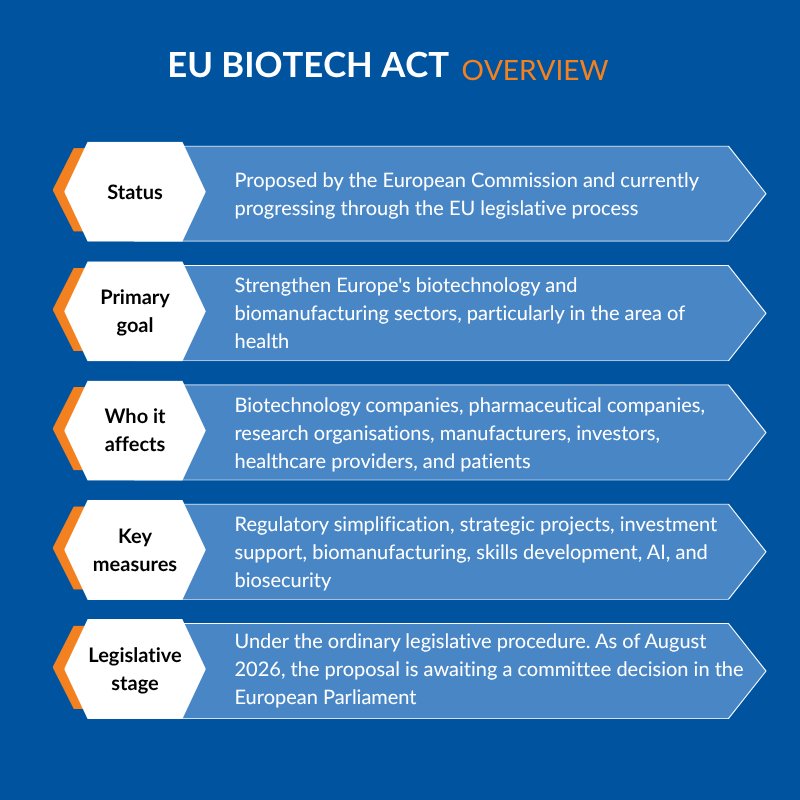
The EU Biotech Act is a proposed Regulation, introduced by the European Commission on 16 December 2025, establishing a framework of measures to strengthen biotechnology and biomanufacturing across the European Union. It forms part of a broader strategy to improve Europe’s competitiveness in life sciences by supporting innovation, attracting investment, expanding manufacturing capacity, and creating a more favourable environment for biotechnology companies to develop and commercialise new products.
The EU Biotech Act consists of a proposed Regulation and a proposed Directive. Together, they introduce targeted regulatory reforms and support measures intended primarily to strengthen the EU’s health biotechnology sector, while also addressing selected issues related to food and feed, industrial biotechnology, and agricultural biotechnology. Its objectives include simplifying regulatory procedures, facilitating access to finance, accelerating the translation of scientific discoveries into commercial applications, strengthening manufacturing capabilities, and encouraging cooperation between research institutions, industry, and public authorities.
The proposed Regulation focuses primarily on health biotechnology, covering human medical, veterinary, pharmaceutical, and phytosanitary applications throughout their lifecycle, from research and funding to testing, manufacturing, market placement, and use. The wider package also introduces targeted changes affecting areas such as food and feed, while a separate initiative addressing the broader biotechnology ecosystem beyond health was expected later in 2026.
As of August 2026, the EU Biotech Act remains a legislative proposal and has not yet entered into force. The proposed Regulation is proceeding under the ordinary legislative procedure and is currently awaiting a committee decision in the European Parliament. It will need to be agreed and formally adopted by the European Parliament and the Council of the European Union before it can enter into force. The proposal is also aligned with a broader set of EU initiatives supporting competitiveness, innovation, investment, skills development, artificial intelligence, and life sciences.
If adopted as proposed, the EU Biotech Act could become an important element of the European Union’s biotechnology and life sciences policy, helping create more favourable conditions for research, innovation, manufacturing, and investment. It also supports the broader EU ambition to become the world’s most attractive place for life sciences by 2030.
Why Was the EU Biotech Act Introduced?
The EU Biotech Act was introduced in response to growing concerns that Europe was losing ground in the global biotechnology race. Although the European Union is home to world-class research institutions, innovative startups, and leading universities, many promising discoveries have struggled to reach commercialisation. Compared with competitors such as the United States and China, European biotechnology companies often face greater regulatory complexity, limited access to private investment, and difficulties scaling innovative products from the laboratory to the market.
“Biotechnology and biomanufacturing are key for the competitiveness and the modernisation of our economy due to their high growth potential and increased labour productivity.” European Commission, Building the Future with Nature: Boosting Biotechnology and Biomanufacturing in the EU (COM(2024) 137 final).
Recognising these challenges, the European Commission identified biotechnology as a critical and strategic technology for Europe’s competitiveness, economic security, resilience, and public health. The proposal aims to create an environment where scientific innovation can move more efficiently from research to real-world applications, while ensuring that Europe remains an attractive place to invest, manufacture, and develop biotechnology.
The initiative also reflects broader global trends. Biotechnology plays an increasingly important role in areas such as personalised medicine, advanced therapies, industrial manufacturing, sustainable agriculture, and environmental technologies. As investment in these sectors continues to grow worldwide, the European Union is seeking to strengthen its position by supporting innovation, reducing unnecessary administrative barriers, and encouraging the commercial development of new technologies.
Ultimately, the EU Biotech Act is intended to help Europe translate its strong scientific foundation into long-term economic growth, increased investment, and faster access to innovative products and technologies. Rather than responding to a single issue, the proposal addresses a combination of scientific, regulatory, economic, and geopolitical challenges that are shaping the future of the global biotechnology industry.
The European Biotech Act is not yet EU law. It is a legislative package consisting of a proposed Regulation and a proposed Directive. Together, the proposals combine amendments to existing EU legislation with new support mechanisms covering areas such as strategic projects, regulatory coordination, investment, skills, and biomanufacturing.
What Are the Main Objectives of the EU Biotech Act?
The EU Biotech Act aims to create a more competitive and innovation-friendly environment for biotechnology across the European Union. Rather than focusing on a single challenge, the proposal introduces a broad range of measures intended to strengthen the EU biotechnology ecosystem, particularly in the area of health.
The European Commission has identified several priority areas that will help improve Europe’s ability to develop, manufacture, and bring innovative biotechnology products to market.
Simplifying the Regulatory Environment
One of the proposal’s primary objectives is to reduce unnecessary regulatory complexity. Biotechnology companies often navigate multiple legal frameworks and approval processes, which can increase costs and delay innovation. The EU Biotech Act seeks to simplify existing procedures where possible, improve coordination between regulatory authorities, and make the overall regulatory landscape more predictable for innovators.
Encouraging Investment and Innovation
Access to funding remains one of the biggest challenges for biotechnology companies, particularly startups and small and medium-sized enterprises (SMEs). The proposal aims to encourage both public and private investment by creating a more attractive environment for innovation while supporting companies as they scale new technologies from research to commercial application.
Strengthening European Biomanufacturing
Scientific innovation alone is not enough to ensure long-term competitiveness. The framework also focuses on expanding Europe’s biomanufacturing capacity, helping innovative products move from the laboratory into large-scale production. This includes supporting advanced manufacturing technologies, improving supply chain resilience, and reducing Europe’s dependence on external production capabilities.
Supporting Research, Talent, and Technology Transfer
The proposal recognises that successful biotechnology ecosystems depend on close collaboration between universities, research organisations, industry, and investors. The proposal includes measures to support technology transfer, address specialised skills needs, attract and retain talent, and strengthen cooperation between universities, research organisations, SMEs, and larger companies.
Strengthening Europe’s Global Competitiveness
Ultimately, the initiative contributes to the EU’s ambition to become the world’s most attractive place for life sciences by 2030. By improving regulation, increasing investment, strengthening manufacturing, and supporting collaboration, the proposal aims to ensure that more scientific discoveries developed in Europe can also be commercialised and manufactured within Europe.
The EU Biotech Act is designed to strengthen the entire biotechnology ecosystem. Its objectives extend beyond regulatory reform to include investment, innovation, manufacturing, technology transfer, skills development, and long-term global competitiveness.
Who Will Be Affected by the EU Biotech Act?
Key takeaway
The proposal is expected to affect a wide range of organisations within the health biotechnology ecosystem and related regulatory areas. Biotechnology companies are at its centre, but the proposed measures may also affect researchers, manufacturers, investors, healthcare organisations, regulators, and patients.
Biotechnology Companies
Biotechnology startups, scale-ups, and established companies are expected to be among the primary beneficiaries of the initiative. The proposal aims to simplify regulatory processes, improve access to funding, and create better conditions for developing, manufacturing, and commercialising innovative products within Europe.
Pharmaceutical and Healthcare Companies
Pharmaceutical companies developing biologics, advanced therapies, vaccines, and other biotechnology-based products could benefit from a more supportive innovation environment and greater regulatory coordination. Healthcare providers and patients could benefit indirectly if the proposed measures help innovative products and services progress through development and regulatory pathways more efficiently.
Universities and Research Organisations
Europe has a strong scientific foundation, yet many research discoveries never reach commercial application. The EU Biotech Act seeks to strengthen technology transfer, encourage collaboration between academia and industry, and help researchers translate scientific innovation into market-ready solutions.
Manufacturers and Supply Chain Partners
The proposal places significant emphasis on expanding Europe’s biomanufacturing capacity. Manufacturers, technology providers, and organisations supporting biotechnology production could benefit from measures designed to strengthen domestic manufacturing capabilities, improve supply chain resilience, and reduce dependence on external production.
Investors and Funding Organisations
Limited access to capital remains one of the biggest barriers to biotechnology innovation. Through initiatives such as BioTechEU (an InvestEU-backed initiative expected to mobilise up to €10 billion in biotechnology investment in 2026 and 2027), the European Union aims to mobilise additional public and private investment, creating new opportunities for venture capital firms, institutional investors, and other organisations that finance biotechnology innovation.
Patients and Society
Although much of the proposal focuses on strengthening the biotechnology sector, its long-term objective is to deliver broader economic and societal benefits. By supporting research, innovation, and the development of new technologies, the initiative aims to improve access to innovative diagnostics, therapies, vaccines, and other biotechnology-based solutions while strengthening Europe’s resilience in healthcare and life sciences.
What Measures Does the EU Biotech Act Propose?
The EU Biotech Act proposes a combination of amendments to existing EU legislation and new support mechanisms covering regulatory simplification, strategic projects, access to finance, biomanufacturing, research, skills, AI, and biosecurity. Together, these measures are intended to strengthen the competitiveness of the EU’s health biotechnology sector while maintaining high safety and quality standards.
Simplifying Regulatory Processes
The proposal introduces targeted amendments to several existing EU legislative frameworks, including those covering clinical trials, advanced therapy medicinal products, substances of human origin, veterinary medicinal products, food safety, and genetically modified organisms. These changes are intended to reduce administrative burdens, shorten procedural timelines, and improve regulatory predictability while maintaining high safety standards.
Proposed Changes to Clinical Trial Procedures
Clinical trials are a central part of the proposed regulatory reforms. The European Biotech Act would amend the EU Clinical Trials Regulation (Regulation (EU) No 536/2014) to shorten authorisation timelines, simplify procedures, and improve coordination between Member States. The proposal also supports greater use of AI and digital tools in clinical trial design and regulatory processes, with the aim of making the EU a more efficient and predictable location for multinational clinical research while maintaining high standards of participant safety and data quality.
The proposal also introduces health biotechnology strategic projects and high-impact health biotechnology strategic projects. Recognised projects could receive faster administrative and regulatory support, targeted scientific and technical assistance, and facilitated access to EU funding. These mechanisms are intended to help promising innovations progress from research and clinical development to manufacturing and market entry more efficiently.
Mobilising Investment
The proposal recognises that scientific innovation requires long-term financial support. Through initiatives such as BioTechEU, the European Union plans to improve access to funding by mobilising public and private investment and strengthening financial instruments available to biotechnology companies, particularly startups and SMEs.
Strengthening Biomanufacturing
The proposal aims to strengthen EU-based biomanufacturing through targeted support for facilities and value chains, including centres of excellence, biosimilar manufacturing, advanced bioprocessing, and AI-enabled production. These measures are intended to improve strategic autonomy and supply resilience for critical health technologies.
Supporting Research and Innovation
The proposal includes actions designed to strengthen collaboration between universities, research organisations, healthcare institutions, and industry. By improving technology transfer, supporting innovation ecosystems, and encouraging knowledge sharing, the initiative seeks to help scientific discoveries move more efficiently from research into commercial application.
Developing Skills and Expertise
Recognising that biotechnology depends on highly specialised expertise, the proposal also includes measures to strengthen workforce development. These actions aim to address skills shortages, attract scientific talent, and ensure that Europe has the expertise needed to support continued growth across the biotechnology sector.
AI, Data, and Biosecurity
The proposal promotes the use of AI, data, and digital solutions across the biotechnology value chain, including research, clinical development, regulatory processes, and biomanufacturing. At the same time, it introduces biosecurity safeguards intended to reduce the risk of biotechnology being misused. These include measures concerning customer verification and the screening of biological sequences associated with products or services that may have significant misuse potential.
What Are the Potential Benefits and Challenges of the EU Biotech Act?
At a glance
The EU Biotech Act has the potential to strengthen Europe’s biotechnology sector by supporting innovation, investment, and manufacturing. However, its long-term success will depend on effective implementation, sustained funding, and close cooperation between the European Union and its Member States.
If the EU Biotech Act were successfully adopted and implemented, it could improve Europe’s ability to transform scientific discoveries into commercially viable products while strengthening its global competitiveness. At the same time, achieving these objectives will require coordinated action across multiple policy areas and institutions.
For organisations working across biotechnology, pharmaceuticals, healthcare, and clinical research, these measures could create more favourable conditions for developing and scaling innovative technologies. Over time, patients may also benefit from improved access to new diagnostics, therapies, and other biotechnology-based solutions.
Despite its ambitious objectives, the success of the initiative is not guaranteed. Many of the proposed measures will require cooperation between EU institutions, Member States, regulators, research organisations, and industry. Differences in administrative capacity, national funding priorities, regulatory coordination, and the practical application of the proposed measures could influence how effectively the initiative achieves its objectives.
It is also important to recognise that biotechnology innovation must continue to balance speed with robust regulatory oversight. Maintaining high standards for safety, quality, and public trust will remain essential as Europe seeks to accelerate innovation across the sector.
Conclusion
The EU Biotech Act marks an important step in the European Union’s efforts to strengthen biotechnology and biomanufacturing. While the proposal is still under discussion, it provides a clear indication of the direction European biotechnology policy is expected to take in the coming years.
By combining regulatory reform, investment, manufacturing support, and stronger collaboration across the innovation ecosystem, the initiative aims to create a more competitive environment for biotechnology in Europe. As the legislative process continues, the EU Biotech Act will remain an important development to follow for organisations across the life sciences sector.
References
- European Biotech Act. European Commission. Accessed: 03 August 2026.
- Proposal for a Regulation to establish measures to strengthen the Union’s biotechnology and biomanufacturing sectors (European Biotech Act). European Commission. Accessed: 03 August 2026.
- Commission Staff Working Document accompanying the proposal for a European Biotech Act, C(2026) 3375 final. European Commission, Directorate-General for Health and Food Safety. Accessed: 03 August 2026.
- European Biotech Act, procedure 2025/0406(COD). European Parliament, Legislative Observatory. Accessed: 03 August 2026.
- Building the Future with Nature: Boosting Biotechnology and Biomanufacturing in the EU (COM(2024) 137 final). European Commission. Accessed: 30 July 2026.
- European biotech act, Laurence Amand-Eeckhout, European Parliamentary Research Service (EPRS). Accessed 03.08.2026.