





















|
Getting your Trinity Audio player ready...
|
At Medicover Integrated Clinical Services, we combine hands-on clinical trial expertise with insights from sources like the World Economic Forum to explore how generative AI in clinical trials is transforming research and where further progress is still needed1.
Generative AI (Gen AI) is opening new opportunities to improve trial design, streamline operations, and increase efficiency across the study lifecycle. In this article, we highlight practical applications of AI already in use and the benefits they bring to clinical development today.
Current Statistics
Let’s start with a few key figures. These are the areas where AI in clinical trials can have the greatest impact helping sponsors and research teams speed up development, reduce costs, and improve outcomes.
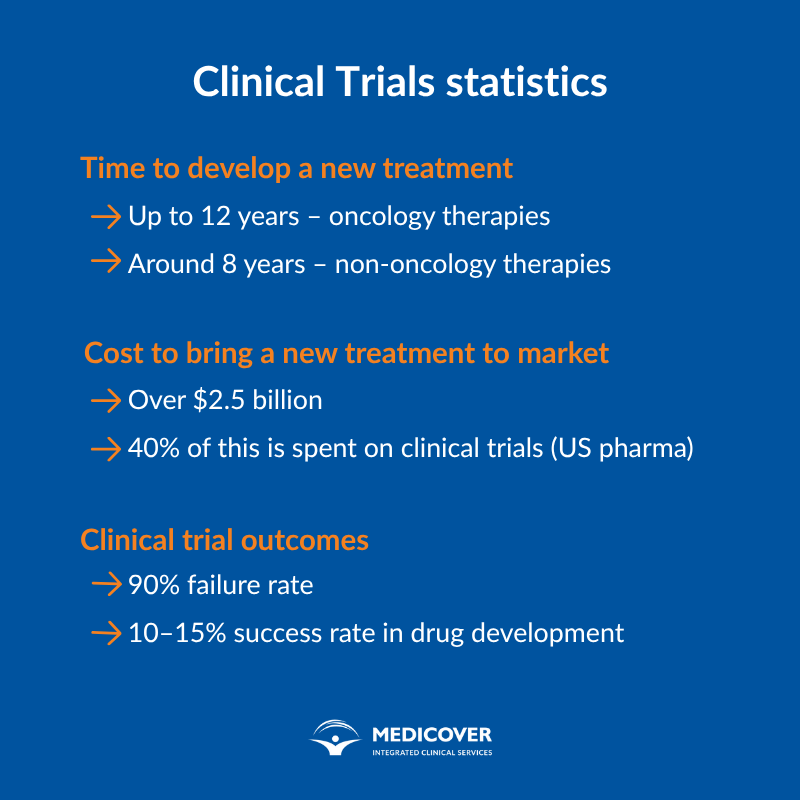
*Underserved groups are populations that have limited access to clinical trials and healthcare. This includes people from minority backgrounds, rural areas, low-income communities, or those facing language or disability barriers. Their underrepresentation can lead to unequal access to new treatments and less inclusive research outcomes.
Inefficiencies in clinical development remain one of the biggest barriers to faster, more affordable drug discovery. Despite ongoing investment and industry focus, the challenge has only grown more complex.
Where AI Brings the Most Value in Clinical Trials
Generative AI in clinical trials is already changing the way we approach drug development. But where exactly can it make the biggest impact in clinical trials? Here are some of the key areas where AI is actively improving how trials are designed, run and evaluated:
- Enabling new trial models – including decentralized clinical trials (DCTs)
- Integrating real-world data – using real-time evidence from clinical practice to inform ongoing research
- Optimizing trial design – helping teams plan smarter, more targeted studies
- Enhancing feasibility and site selection – identifying the right locations and patient populations
- Streamlining clinical operations – reducing delays and manual workloads
- Automating data analysis – improving speed and consistency of insights
- Accelerating regulatory submissions – reducing errors and improving timelines
A ZS analysis found that a typical top-10 pharma company could save over $1 billion in five years by implementing AI-driven trial design and decentralized trial models2.
Of course, theory and practice don’t always align. While AI in clinical trials holds enormous potential, its adoption in real-world clinical research is not without challenges. Many organizations face fragmented data systems and a lack of consistent data standards or supporting infrastructure. There are often limited incentives for data sharing, compounded by a general resistance to change across the industry. On top of that, regulatory expectations remain unclear in some areas, and there’s still a noticeable gap in the skills and knowledge needed to fully harness AI tools.
Let’s now explore much deeper how AI is already being applied across specific areas of clinical research.
Five Areas of Clinical Development Ready for AI Transformation
In interviews conducted by the World Economic Forum and ZS, clinical development leaders pointed to five core processes where Gen AI offers the greatest potential to reduce trial costs and timelines, while improving study success rates. One of the most immediate areas of impact is clinical trial design.
- Clinical trial design
Designing clinical trials remains one of the most complex stages of drug development, often delayed by manual tasks, reliance on historical data, and subjective decision-making. These factors can lead to protocols that are poorly aligned with patient populations or operational realities, resulting in costly amendments, delays, and a higher risk of failure.
Generative AI can enhance trial design by analyzing both structured and unstructured data, including previous studies, real-world evidence, and scientific literature. It can help define digital and surrogate endpoints, predict patient eligibility, and refine inclusion and exclusion criteria. Additionally, Gen AI supports protocol drafting by automating time-consuming steps, reducing human error, and easing administrative burden.
This shift enables trial teams to build better-designed studies from the start, reducing delays and improving the chances of success.
- Trial feasibility and site selection
Feasibility assessment and site selection often rely on limited data and past site performance, overlooking more relevant factors like patient demographics, disease prevalence, and trial-specific capabilities. Data silos and the lack of real-time insights lead to poor site choices, under-enrolment and delays.
Generative AI can process both historical trial data and real-world data to predict site performance more accurately. Combined with predictive models, it helps identify optimal sites, estimate recruitment potential, and simulate different site strategies. It also supports decentralized trials by managing the added complexity of multiple locations, making studies more accessible and patient-focused.
- Clinical operations – patient recruitment and retention
Patient recruitment still depends on time-consuming methods like physician referrals, registries and site-led outreach, which often struggle to reach diverse populations. Retention services efforts, such as reminders and incentives, are typically generic and fail to maintain participant engagement throughout the trial.
Generative AI is changing this by analyzing data from sources like electronic health records, insurance claims, and patient advocacy groups to identify and reach more diverse candidates. It also supports predictive models that flag patients at risk of dropping out and recommend tailored interventions. This allows teams to create more personalized engagement strategies, improving both recruitment and retention outcomes.
- Data analysis
As data collection methods become more advanced, trial teams face increasing challenges with data quality, integration, and analysis. Analysts often work with fragmented sources like EHRs, lab results, and patient-reported outcomes, which require time-consuming cleaning and preparation. Even partially automated coding and statistical tasks still demand specialized expertise and are prone to delays or errors.
Generative AI can act as a co-pilot, automating tasks such as code writing, table generation, and data cleaning. It can quickly integrate data from various sources, including wearables and digital tools, and prepare it for analysis. This shortens the time from data collection to actionable insights, improving efficiency across the development life cycle3.
- Regulatory submission and review
The growing complexity of clinical trials has led to longer submission timelines and a 60% increase in trial procedures over the past decade. Many companies still use manual methods for regulatory submissions, which often results in filing errors, duplicated efforts, and inconsistent documentation due to siloed teams.
Generative AI can streamline this process by automating the generation, organization, and validation of submission documents. It can compile trial data into the correct formats, flag missing information, and ensure compliance with regulatory requirements. Gen AI may also support predictive tools to estimate the likelihood of approval, helping teams plan more effectively and avoid delays.
Implementation of AI – case studies
Cancer detection
Researchers have developed an AI‑powered liquid biopsy technique that significantly enhances sensitivity in detecting circulating tumor DNA (ctDNA) in the blood. In a multi‑cancer study conducted at Weill Cornell Medicine, NewYork‑Presbyterian, NY Genome Center, and Memorial Sloan Kettering, a machine learning model analyzed sequencing data from patient blood samples, accurately identifying minimal residual disease and early-stage cancers including lung, breast, colorectal, and melanoma. This approach demonstrated unprecedented sensitivity in predicting recurrence and detecting cancer earlier than standard clinical methods, offering promise for non‑invasive, real‑time cancer monitoring and treatment planning4.

Lung Cancer Treatment
In lung cancer management, artificial intelligence is increasingly supporting clinicians in both diagnosis and treatment planning. For example, AI algorithms trained on thousands of imaging scans can now detect malignant lung nodules on CT scans with accuracy comparable to or even exceeding that of experienced radiologists. In clinical practice, these tools have been used to distinguish between benign and malignant lesions, reducing the need for unnecessary biopsies and enabling earlier intervention.
Beyond imaging, AI has also been applied to predict tumor genomics and classify cancer subtypes using data from pathology slides and electronic health records. This helps personalize treatment strategies, such as selecting targeted therapies based on predicted molecular profiles. While challenges remain – such as data standardization and ensuring model transparency – AI is already proving to be a valuable co-pilot in delivering more precise, efficient lung cancer care5.
Prostate cancer
Researchers have recently demonstrated how artificial intelligence can uncover new insights into prostate cancer by analyzing genetic data from patients. By applying AI to whole-genome sequencing, scientists identified distinct subtypes of the disease that carry different levels of risk. This approach has the potential to improve how patients are classified and treated, moving closer to more personalized and effective cancer care6.
Moreover, a recent international study showed that artificial intelligence can outperform radiologists in detecting prostate cancer on MRI scans. The AI system demonstrated higher accuracy and fewer false alarms, helping identify significant cancers more reliably. This approach could reduce unnecessary procedures and support faster, more confident diagnoses, offering real value to both clinicians and patients7.
Early Autism Detection
A recent study highlights how artificial intelligence can significantly improve early detection of autism spectrum disorder. Using routinely collected developmental and behavioral information from large patient datasets, researchers trained an AI model that was able to identify children at risk of autism with around 80% accuracy. The system was tested on tens of thousands of cases and showed consistent results across different age groups. This method could help shorten the time to diagnosis and enable earlier access to support, which is especially important given that many children today are diagnosed only after the age of four. AI-powered screening tools like this could play a vital role in making developmental care more proactive and accessible8.
Prediction of Treatment Response
A recent study demonstrates how artificial intelligence can use tumor genetic data to predict how patients will respond to chemotherapy. Researchers analyzed genetic profiles from thousands of tumors and trained an AI model to detect patterns linked to treatment resistance or sensitivity. In one of the tested cancer types, up to 35% of tumors do not respond well to standard therapy. The AI approach showed promising accuracy in identifying which patients were more likely to benefit. This kind of tool could support more personalized treatment decisions and improve the design and targeting of clinical trials9.
Why AI Implementation in Clinical Trials Matters
The future of global health depends on making clinical development more efficient, accessible, and sustainable. Implementing generative AI in clinical trials is not just a technological upgrade; it is both a moral and financial necessity. As drug development becomes more complex and costly, AI can streamline processes, reduce timelines, and help manage rising expenses. It supports better trial design, faster regulatory approvals, and improved patient access to critical therapies. For governments, pharmaceutical companies, and patients, the potential benefits are significant. AI offers a more effective path to addressing today’s healthcare challenges.
FAQ – AI in clinical trials
1. What is AI in clinical trials
AI in clinical trials refers to the use of artificial intelligence technologies – such as machine learning, natural language processing, and generative AI – to improve how clinical trials are designed, conducted, and analyzed. It supports faster decision-making, enhances patient recruitment, and enables more personalized treatment strategies.
2. How does AI in clinical trials improve clinical trial design?
AI in clinical trials can analyze large volumes of historical and real-world data to optimize trial protocols, identify the most relevant inclusion and exclusion criteria, and reduce unnecessary complexity. This leads to shorter setup times, fewer amendments, and better alignment with patient populations.
3. Can AI in clinical trials help with patient recruitment and retention?
Yes. AI in clinical trials helps identify eligible participants by analyzing electronic health records, genetic data, and real-time behavioral inputs. It can also predict dropout risks and suggest personalized engagement strategies to improve retention.
4. What role does AI in clinical trials play in data analysis during research?
AI in clinical trials automates many aspects of clinical data processing, from cleaning and organizing datasets to performing statistical analysis. This reduces the time and effort required by human analysts and minimizes the risk of errors.
5. Is AI in clinical trials used in regulatory submissions ?
Emerging AI solutions assist with regulatory processes by generating structured documents, checking for compliance, and predicting the likelihood of approval. This can reduce filing errors and accelerate submission timelines.
6. What are real-world examples of AI in clinical trials?
Recent studies have shown AI outperforming radiologists in prostate cancer detection, identifying early signs of autism, predicting tumor response to therapy, and improving the accuracy of liquid biopsies. These examples highlight how AI in clinical trials is already transforming multiple therapeutic areas.
References
- Intelligent Clinical Trials: Using Generative AI to Fast‑Track Therapeutic Innovations, World Economic Forum (in collaboration with ZS – global consulting and technology company specializing in healthcare), We Forum Intelligent Clinical Trials , access date: 28.07.2025 ↩︎
- White Paper, Successful Digital Transformation, access date: 17.10.2025 ↩︎
- Using AI to Speed and Simplify Site Validation, Clinical Tech Leader, access date: 28.07.2025 ↩︎
- AI-Powered Liquid Biopsy Delivers Ultrasensitive Cancer Detection, Inside Precision Medicine, access date: 28.07.2025 ↩︎
- The Use of Artificial Intelligence in Lung Cancer Management, Inside Precision Medicine, access date: 28.07.2025 ↩︎
- Artificial Intelligence Reveals Two Prostate Cancer Subtypes with Different Levels of Risk, Inside Precision Medicine, access date: 28.07.2025 ↩︎
- AI Outperforms Radiologists in Detecting Prostate Cancer on MRI Scans, Inside Precision Medicine, , access date: 28.07.2025 ↩︎
- AI Can Spot Autism Early and Accurately, Inside Precision Medicine, access date: 28.07.2025 ↩︎
- AI Uses Tumor Genetics for Prediction of Treatment Response, Inside Precision Medicine, , access date: 28.07.2025 ↩︎