





















|
Getting your Trinity Audio player ready...
|
Executive summary
Laboratory-generated analytical data play a critical role in modern clinical trials. Safety assessments, biomarker quantification, immunogenicity testing, and pharmacodynamic analyses all depend on the accuracy and reliability of laboratory results. For sponsors, biotech companies, and CROs, the integrity of these data directly influences study outcomes, regulatory decisions, and the overall success of a drug development programs.
GCLP laboratory operates in accordance with Good Clinical Laboratory Practice (GCLP) principles – a globally recognized quality framework governing laboratories that analyze clinical trial samples. These standards ensure that laboratory activities are conducted under controlled conditions, with well-defined procedures, full traceability, and robust quality oversight.
By partnering with a GCLP laboratory, sponsors can be confident that laboratory-generated analytical data are scientifically robust, reproducible, and fully suitable to support regulatory submissions.
What Is a GCLP-Compliant Laboratory?
GCLP laboratory is a laboratory that follows Good Clinical Laboratory Practice standards when analyzing samples collected during clinical trials.
GCPL integrates quality principles derived from both Good Clinical Practice (GCP) and Good Laboratory Practice (GLP), creating a dedicated framework for laboratories supporting clinical research.
The focus of GCLP is the proper handling, processing, and analysis of biological samples collected from study participants to ensure that every result generated can be traced, verified, and trusted.
For sponsors and CROs, working with GCLP-compliant laboratory means that the analytical component of their clinical studies is supported by a quality management system designed to deliver reliable and verifiable results.
GCLP vs GLP vs GCP – Understanding the Regulatory Landscape
Clinical research operates within several complementary regulatory frameworks, each addressing a different aspect of the development process.
Good Clinical Practice (GCP) governs the conduct of clinical trials involving human participants. Its primary focus is patient safety, ethical standards, and the credibility of clinical data collected at investigational sites.
Good Laboratory Practice (GLP) applies primarily to non-clinical laboratory studies, including toxicology and safety testing performed before investigational therapies are evaluated in humans.
Good Clinical Laboratory Practice (GCLP) bridges these frameworks by establishing quality standards for laboratories that analyze clinical trial samples. It ensures that laboratory-generated analytical data used in clinical research meet expectations for traceability, documentation, and analytical reliability.
For sponsors, this distinction is particularly important, as laboratory data frequently support key clinical endpoints and must withstand regulatory scrutiny during inspections and submission reviews.
Advantages of Using a GCLP Laboratory in Clinical Trials
1. Regulatory Compliance
GCLP-compliant laboratories operate under documented procedures, with validated analytical methods, and controlled workflows aligned with internationally recognized standards. This structured approach ensures that laboratory testing is conducted in a controlled and auditable environment.
Data generated in a GCLP-compliant laboratory is more likely to meet the expectations of regulatory authorities such as the FDA (Food and Drug Administration), EMA (European Medicines Agency), and MHRA (Medicines and Healthcare products Regulatory Agency). This reduces regulatory risk and allows laboratory results to be confidently included in clinical study reports and regulatory submissions.
2. Data Integrity and Reliability
Reliable laboratory data are essential for evaluating the safety and efficacy of investigational therapies.
GCLP-compliant laboratories implement standardized operating procedures (SOPs) that define each step of the pre-analytical, analytical, and post-analytical processes, from sample receipt and preparation, to testing and data reporting.
Sponsor benefit from consistent, accurate, and reproducible analytical results that strengthen the credibility of clinical endpoints and support data-driven decision making during drug development.
3. Quality Assurance and Quality Control
A key component of GCLP compliance is the presence of an independent Quality Assurance (QA) function responsible for monitoring laboratory activities and verifying adherence to established procedures.
Routine internal audits, equipment calibration, method validation, and proficiency testing programs help maintain high analytical standards and operational accuracy.
Sponsors gain additional confidence that laboratory operations are continuously monitored and that any deviations are properly documented, investigated, and addressed in accordance with quality standards.
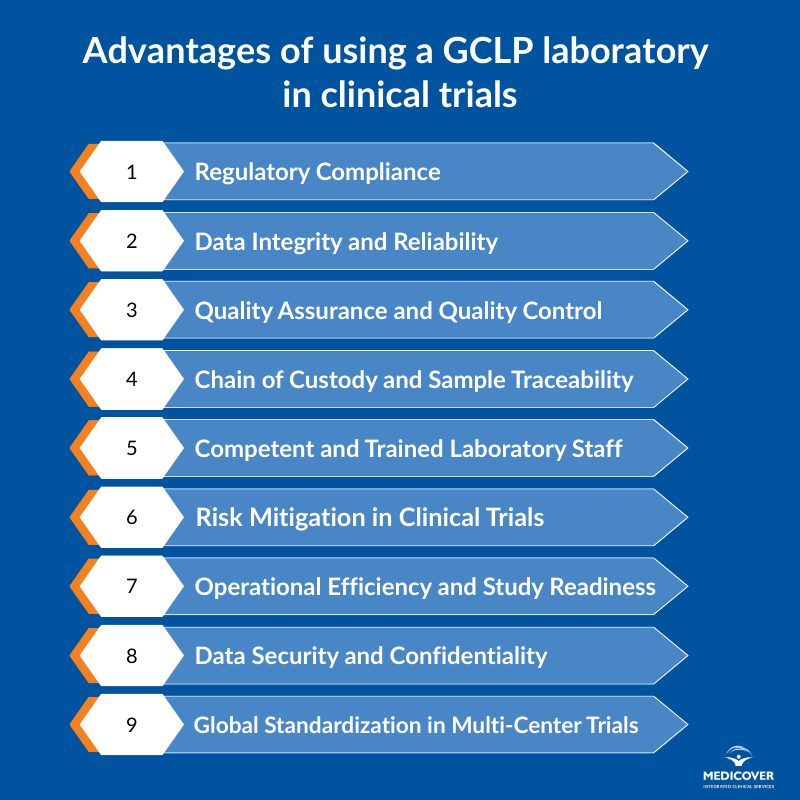
in clinical trials, Medicover Integrated Clinical Services
4. Chain of Custody and Sample Traceability
Clinical trial samples often travel between multiple locations – investigative sites, central laboratories and specialized testing facilities. GCLP-compliant laboratories maintain detailed documentation tracking each step in the lifecycle of each sample, including:
A GCLP laboratory maintains detailed documentation that tracks the entire lifecycle of each sample, including:
- sample receipt and accessioning
- storage conditions
- preparation and analytical procedures
- disposal.
For sponsors, complete sample traceability within a defined chain of custody ensures that every analytical result can be linked to the correspondent participant sample. This, in turn, supports data verification, facilities regulatory inspections, and strengthens overall study integrity.
Learn more about The Laboratory Sample Journey: From a well-done Setup to Tracking and Delivery.
5. Competent and Trained Laboratory Staff
Laboratory quality depends not only on technology but also on the expertise of the personnel performing the analyses. GCLP laboratory requires structured training programs and ongoing competency assessments for laboratory personnel. Personnel must demonstrate proficiency in laboratory techniques, documentation practices, and regulatory requirements.
For sponsors, this ensures that laboratory testing is performed by trained professionals who understand both analytical techniques and the regulatory context associated with clinical research.
6. Risk Mitigation in Clinical Trials
Laboratory errors in clinical trials – such as sample mislabeling, contamination, or incorrect reporting – can have serious impact on participant safety and data integrity, potentially leading to protocol deviations, repeat testing, or delays in study timelines.
By adopting a risk‑based approach, GCLP laboratories actively monitor critical processes and mitigate potential non‑conformities at an early stage, reducing the likelihood of issues long before they can impact study quality.
Sponsors and CROs benefit from reduced operational risk and greater confidence in the reliability of laboratory data supporting their clinical programs.
7. Operational Efficiency and Study Readiness
Laboratories following GCLP guidelines deliver a consistently high-quality experience through clearly defined processes for study setup, sample management, and data reporting. This structured, quality-driven approach accelerates study start-up and ensures smooth, predictable execution across every phase of the project. With robust systems and disciplined workflows, a GCLP laboratory is often exceptionally well positioned to support global trials with complex study designs, and high-volume sample operations.
Sponsors can expect operational readiness which contributes to more efficient study management and improved timeline predictability.
8. Data Security and Confidentiality
Clinical trials generate highly sensitive participant and research data that must be safeguarded with the utmost rigor.
GCLP-compliant laboratories implement apply robust data-governance policies, combining secure information systems, controlled access to laboratory databases, and detailed audit trails. This disciplined approach ensures strong protection of personal and study-critical information, while supporting compliance with international data-privacy regulations such as GDPR (General Data Protection Regulation – a European Union regulation governing personal data collection, processing, storage, and protection) and HIPAA (Health Insurance Portability and Accountability Act – a US law establishing standards sensitive patient health information protection).
Sponsors are provided with confidence that data integrity, confidentiality and regulatory obligations are upheld at every step.
9. Global Standardization in Multi-Center Trials
Many modern clinical trials involve multiple countries, investigative sites, and laboratories. GCLP laboratory applies standardized methodologies and validated procedures to ensure consistent analytical performance across studies and locations.
Such standardization supports reliable data comparability across study sites, enabling data pooling and accurate statistical analysis.
Conclusion
Reliable laboratory testing is cornerstone of successful clinical trials. Laboratory results underpin key endpoints, safety evaluations, and regulatory submissions, making data integrity essential.
By operating under rigorous quality standards, a GCLP laboratory ensures that laboratory data generated during clinical trials is accurate, traceable, and aligned with regulatory expectations.
For sponsors, biotech companies, and CROs, partnering with a GCLP laboratory enhances data credibility, minimizes regulatory risk, and supports the development of high-quality clinical evidence required for successful regulatory approval.
FAQ – GCLP Laboratory in Clinical Trials
1. What is a GCLP laboratory?
A GCLP laboratory is a laboratory that follows Good Clinical Laboratory Practice guidelines when analyzing biological samples collected during clinical trials. These standards ensure that laboratory testing is performed using validated methods, documented procedures, and controlled processes that generate reliable and traceable clinical data.
2. What does GCLP stand for in clinical research?
GCLP stands for Good Clinical Laboratory Practice. It is a quality framework designed for laboratories performing analyzes on clinical trial samples. A GCLP laboratory maintains strict quality systems to ensure the accuracy, integrity, and traceability of laboratory results used in clinical research.
3. What is the difference between a GCLP laboratory and a GLP laboratory?
A GLP laboratory typically supports non-clinical research, such as toxicology studies conducted prior trials involving human participants. In contrast, a GCLP laboratory focuses on testing biological samples obtained directly from clinical trial participants. GCLP incorporates quality principles from both GLP and GCP, ensuring laboratory data generated in clinical studies meet regulatory expectations.
4. Is GCLP required for clinical trial laboratories?
Although GCLP is not a legal requirement, the GCLP-compliance is widely expected by sponsors and regulatory bodies. Operating under GCLP principles ensures that laboratory data aligns with internationally recognized quality standards and are suitable for regulatory submissions.
5. Why do sponsors choose a GCLP laboratory for clinical trials?
Sponsors rely on GCLP-compliant laboratories because they provide reliable testing, robust documentation practices, and full traceability of samples and results. These factors reduce regulatory risk and enhance the credibility of laboratory data used to support clinical trial outcomes.
6. What types of analyses are performed in a GCLP laboratory?
GCLP-compliant laboratories can conduct a broad spectrum of analyses, including safety laboratory testing, biomarker evaluations, pharmacokinetic assessments, immunogenicity assays, and molecular diagnostics. These tests generate essential data used for assessing the safety and efficacy of investigational therapies.
References
- World Health Organization, Good Clinical Laboratory Practice (GCLP), WHO, 2009, [access date: 06.03.2026]
- Joshi R.K., A Comparative Review of ICMR, WHO, and EMA Good Clinical Laboratory Practice Guidelines, Journal of Laboratory Physicians, 2022, [access date: 06.03.2026]
- European Medicines Agency, ICH E6 Good Clinical Practice – Scientific Guideline, EMA, [access date: 06.03.2026]
- Hyun S., Importance and Future Direction of Applying GCLP in Clinical Trial Sample Analysis, Korean Citation Index, 2024, [access date: 06.03.2026]