






















|
Getting your Trinity Audio player ready...
|
Longevity has become an increasingly important topic in modern medicine, but its scientific foundation is firmly rooted in clinical trials. In medical testing, longevity is not about extending lifespan as a concept, but about measuring long-term biological processes through structured, repeatable, and regulated diagnostics.
Within clinical trials, longevity testing supports the assessment of long-term safety, biological response, and durability of therapeutic effects. It transforms laboratory diagnostics from isolated measurements into longitudinal clinical evidence that can be reliably interpreted over time.
Longevity Testing: A Clinical Trials Perspective
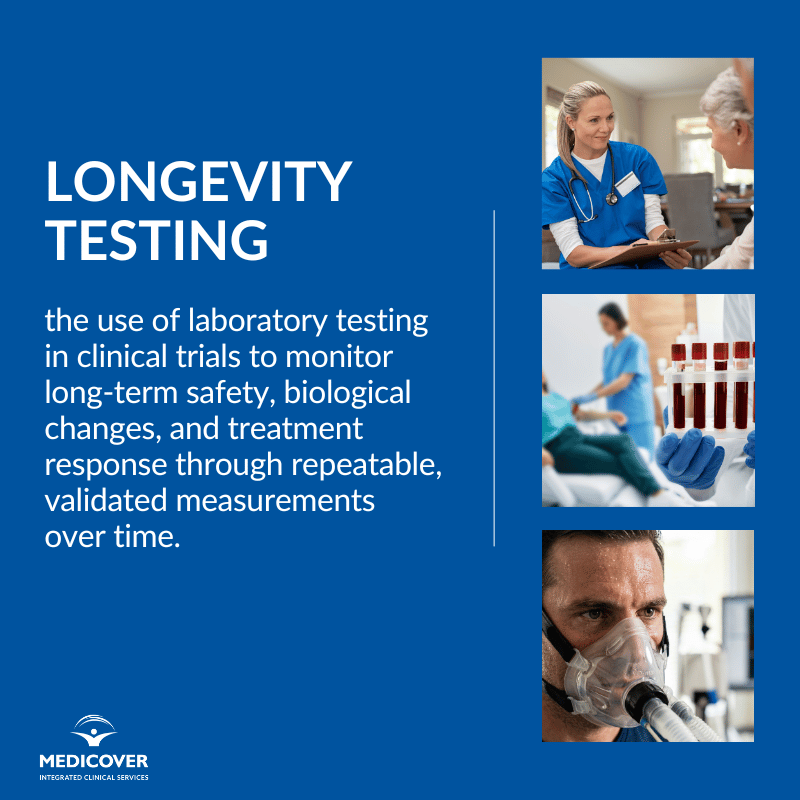
Longevity testing refers to the systematic use of laboratory diagnostics to observe biological change over time. In regulated environments, particularly in longevity testing in clinical trials, this approach is operationalised through predefined protocols, validated analytical methods, and consistent data collection across multiple time points.
Unlike routine diagnostics performed at a single moment, longevity testing in clinical trials is designed to:
- capture biological trends rather than isolated snapshots,
- differentiate natural aging from treatment-related effects,
- support long-term safety assessment,
- generate data suitable for regulatory evaluation.
This perspective is especially relevant in studies addressing chronic diseases, aging-related conditions, and therapies intended for extended or lifelong use.
Longevity Testing Across the Clinical Trial Lifecycle
Longevity testing delivers its greatest value when embedded across the entire clinical trial lifecycle, rather than treated as a standalone analytical activity.
During study design and feasibility, laboratory testing helps define eligibility criteria and baseline parameters that account for aging-related variability. This reduces the risk of confounding factors and supports more robust, well-characterized study populations.
At baseline, safety testing combined with biomarker analysis establishes a strong biological reference point for each participant. This enables meaningful stratification and improves the sensitivity of downstream analyses when assessing change over time.
As trials progress, longitudinal laboratory testing becomes central to evaluating therapeutic impact. Repeated measurements allow researchers to:
- track biological trends over time,
- assess durability of response,
- detect subtle changes that may precede clinical outcomes.
Throughout the study, safety testing plays a continuous role in protecting participants and supporting informed decision-making, particularly in trials involving long treatment exposure. When interpreted against individual baselines rather than population ranges alone, safety parameters offer greater sensitivity to clinically relevant change.
Biomarkers further strengthen longevity-oriented trials by supporting:
- monitoring of biological response,
- exploration of mechanisms of action,
- secondary and exploratory endpoints,
- data generation for future development phases.
When applied consistently across study phases, longevity testing in clinical trials supports both scientific interpretation and long-term evidence generation.
Frameworks Supporting Longevity-Oriented Trials
Longevity testing in clinical trials relies on laboratory testing frameworks designed for consistency, repeatability, and long-term comparability.
Routine safety laboratory testing forms the physiological foundation of these studies and typically includes:
- hematology parameters,
- clinical chemistry assessing liver, kidney, and metabolic function,
- key markers of systemic stability and inflammation.
Safety testing
Laboratory testing performed to assess baseline health status and to monitor organ function, physiological stability, and potential adverse effects over time. In clinical trials, safety testing is essential for participant protection and regulatory compliance
Beyond safety parameters, biomarker testing provides deeper insight into biological processes associated with aging and disease progression. When implemented within validated analytical frameworks, biomarkers support patient stratification, longitudinal monitoring, and scientifically robust endpoints.
At Medicover Integrated Clinical Services, biomarker capabilities are integrated into clinical trial operations, supporting biomarker development, validation, and testing under controlled laboratory conditions. This integration ensures consistency of data generation and supports reliable interpretation of long-term biological effects
Longevity Testing and the Future of Clinical Trial Design
As clinical development increasingly focuses on chronic conditions and long-term outcomes, longevity testing is becoming an essential element of future clinical trial design.
Sponsors are placing greater emphasis on:
- longitudinal data collection,
- biomarker-driven insights,
- extended safety monitoring,
- integration of laboratory data across development phases.
In this evolving landscape, medical testing moves beyond a supporting role. Embedded into structured research frameworks, longevity testing in clinical trials enables evidence-based decisions, supports regulatory confidence, and strengthens the scientific value of long-term clinical research.
Looking for a Central Lab Partner with Specialized Testing Capabilities?
References
- A Model for Estimating Biological Age From Physiological Biomarkers of Healthy Aging: Cross-sectional Study, JMIR Aging, access date: 30.01.2026
- Development and Validation of a Healthy Longevity Index for Personalized Healthy Aging in Primary Care, JMIR Aging, access date: 30.01.2026
- Artificial Intelligence-Driven Biological Age Prediction Model Using Comprehensive Health Checkup Data: Development and Validation Study, JMIR Aging, access date: 30.01.2026
1. What is longevity testing in clinical trials?
Longevity testing in clinical trials refers to longitudinal laboratory testing used to monitor long-term safety, biological changes, and treatment response through repeatable and validated measurements over time.
2. How is longevity testing different from routine medical testing?
Routine medical testing usually provides a single snapshot of health, while longevity testing focuses on trends over time, enabling assessment of durability of effects, delayed responses, and long-term safety in clinical trials.
3. Why is longevity testing important for long-term clinical studies?
Longevity testing allows sponsors and researchers to better understand cumulative treatment effects, long-term safety profiles, and biological changes that may not be visible in short-duration studies.
4. What role do biomarkers play in longevity testing?
Biomarkers support this testing testing by enabling patient stratification, monitoring of biological response, and exploration of mechanisms of action, particularly when integrated into longitudinal clinical trial designs.
5. Which types of clinical trials benefit most from longevity testing?
Longevity testing is especially relevant for clinical trials involving chronic diseases, aging-related conditions, preventive therapies, and treatments intended for long-term or lifelong use.