




















|
Getting your Trinity Audio player ready...
|
Patient recruitment for clinical trials is one of the most critical and challenging aspects of running a successful clinical research. Despite advancements in technology and increased awareness of research participation, an estimated 80% of trials still face delays due to difficulties in enrolling the right number and type of participants.1
As trial designs become more complex and the need for diverse, representative populations grows, Sponsors and CROs must focus on tailored recruitment strategies and work with experienced partners to keep both timelines and budgets on track.
Statistics of Patient Recruitment for clinical trials
Recruiting and retaining participants remains one of the most pressing challenges in clinical research. Despite its critical role in study success, patient recruitment for clinical trials continues to be a major bottleneck – leading to delays, added costs, and, in many cases, study failure.
Here are some key figures that highlight the scale of the issue:
- 55% of clinical trials are terminated globally due to low recruitment.
- Only 40% of Phase III and IV trials reach their enrollment targets worldwide.
- Just 7% of enrolled patients globally complete the study.
- Up to 37% of trial sites fall below enrollment target
- 11% of clinical research sites fail to enroll in a single patient.
- More than 80% of trials struggle to enroll on schedule, often requiring additional sites.
- In the U.S., over 80% of trials fail to meet their enrollment targets.
- 30% of U.S. participants discontinue their participation before study completion.
- 9 out of 10 trials ultimately take twice as long as planned to meet enrollment goals2.
Key Challenges in Patient Recruitment
Recruiting patients for clinical trials involves far more than simply meeting enrollment targets. It requires close coordination between Sponsors, research sites, and operational teams, with attention to eligibility criteria, timelines, patient experience, and trust. Yet, despite the increasing need for clinical research, a wide range of challenges continue to hinder effective recruitment and retention services.
A study published by the National Cancer Institute outlined several key reasons why patients discontinue their participation in trials3:
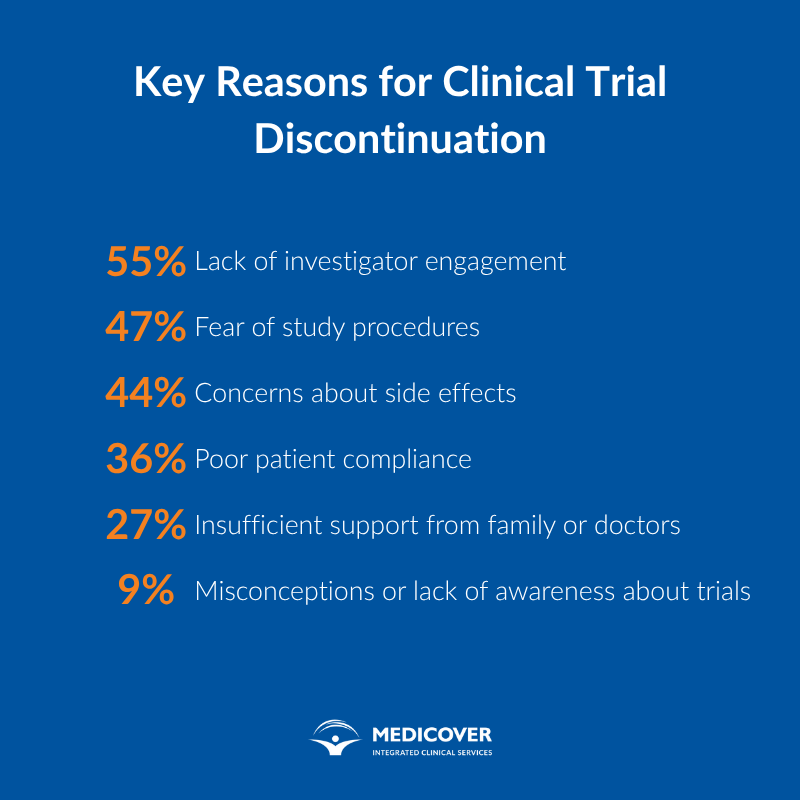
These insights help frame the broader barriers to patient participation, which fall into two main categories:
1. Challenges Related to Study Participants
Patients often face practical, emotional, and logistical obstacles that discourage participation, even when the study may benefit their health:
- Time constraints – Patients with full-time jobs or caregiving responsibilities may struggle to attend frequent study visits. Hourly workers and single parents, in particular, face high participation burdens.
- Long-distance travel – Geographic barriers and associated costs may prevent patients from reaching trial sites.
- Concerns about placebo – Some are hesitant to participate if there’s a chance they will not receive the active treatment.
- Fear of side effects – Worries about unknown reactions to investigational products are common.
- Perception of standard treatment – Patients may believe that their current care is safer or more effective.
- Fear of being a test subject – Concerns about being treated as “experimental” still persist.
- Discouragement from others – Friends, relatives, or even primary care providers may advise against participation.
- Chronic conditions – Patients managing ongoing diseases may be reluctant to add new medications or procedures.
- Lack of understanding – Misconceptions or incomplete information about clinical trials can create resistance.
Around 80% of trials fail to meet the initial enrollment target and timeline, and these delays can result in lost revenue of as much as US $8 million per day for drug developing companies.4
2. Challenges Related to the Clinical Trial Process
Beyond individual concerns, the structure and planning of trials can also limit recruitment efforts:
- Limited promotional budgets – Sponsors often allocate a modest marketing budget, which may run out within the first few months of recruitment.
- Low public awareness – According to CISCRP, only 5% of participants learned about clinical trials through online communities, and just 16% from general advertisements.
- 73% of patients say they would prefer to learn about trials through their doctor’s office.
- 42% would trust advocacy groups or nonprofits for this information.
- Only 21% would rely on media advertising (print, online, TV, radio).
- Stringent eligibility criteria – Narrow inclusion/exclusion parameters significantly reduce the pool of eligible participants. In some studies, specific lab result requirements alone have caused up to 59% of screen failures.
- Protocol complexity – Intensive testing, long duration, and frequent visits can deter participation and often lead to protocol amendments or additional sites to meet targets.
- Challenging indications – Some medical conditions, particularly rare diseases or oncology, come with strict definitions and low prevalence, making patient identification difficult5.
Addressing patient recruitment for clinical trials challenges requires more than simply identifying the obstacles. It calls for proactive, flexible, and patient-centered solutions. By understanding both individual and systemic barriers, Sponsors and CROs can design strategies that better support diverse populations and complex study designs. The next section outlines effective approaches to improve recruitment outcomes across different trial settings.
Effective Strategies to Improve Patient Recruitment for clinical trials
Recruiting the right participants within a defined timeframe is one of the most demanding aspects of clinical trial execution. When enrollment falls short, trials risk delays, increased costs, or compromised data quality. To avoid these outcomes, Sponsors and CROs need practical, patient-focused strategies that have demonstrated success across different trial settings.
Below are key approaches that can improve patient recruitment for clinical trials efficiency and participant engagement:
1. In-Person and Referral-Based Recruitment
In-person recruitment remains one of the most effective and cost-efficient strategies. Direct interaction with potential participants fosters trust and allows for immediate clarification of study details. Additionally, referrals from site staff and current participants can significantly increase outreach.
- Engage patients during routine clinical visits.
- Encourage participants to share information with friends or family members who may qualify.
- Attend or organize community health events to raise visibility.
- Use trusted physician networks for direct referrals.
2. Digital Outreach and Advertising
Digital channels can complement in-person strategies by extending reach and improving targeting.
- Launch social media campaigns and share updates on institutional websites and health platforms.
- Use geo-targeted ads and online pre-screening tools to reach specific populations.
- Combine demographic data and electronic health records to identify and pre-qualify patients more efficiently.
These methods are particularly effective among younger populations but work best when part of a broader outreach plan.
3. Patient-Centered Communication
Clear, accessible, and empathetic communication helps build trust and improves enrollment outcomes.
- Use materials written at a 7th to 8th grade reading level.
- Avoid technical language in brochures, consent forms, and instructions.
- Offer real-time discussions or counseling to help participants understand the study purpose and procedures.
- Maintain open lines of communication throughout the patient recruitment for clinical trials process.
4. Flexible Trial Design and Logistical Support
Reducing the burden of participation encourages more people to take part and stay involved.
- Implement hybrid or decentralized trial models where feasible.
- Offer options such as weekend appointments, home visits, or local satellite locations.
- Provide reimbursement for expenses related to study participation, including travel, meals, childcare, and lost wages.
5. Trust and Retention Practices
A supportive environment improves both patient recruitment for clinical trials and long-term engagement.
- Treat participants as valued contributors, not just study subjects.
- Send thank-you notes, reminders, and follow-up calls between visits.
- Involve family members and caregivers where appropriate.
- Build long-term trust by maintaining consistent and respectful communication.
6. Site Preparation and Staff Training
Sites play a central role in patient recruitment for clinical trials success. Well-trained and well-supported teams lead to better performance.
- Involve site staff early in study planning to gather input on feasibility.
- Ensure investigators and coordinators are prepared to answer scientific and logistical questions.
- Allocate budget to recruit, train, and retain experienced staff.
- Use trial management systems to track outreach and streamline communication.
7. Community Outreach and Awareness
Raising awareness about clinical research creates long-term recruitment potential.
- Organize informational sessions in collaboration with patient advocacy groups.
- Address misconceptions about clinical trials, especially among underserved populations.
- Support physicians in introducing clinical trial opportunities during routine care.
8. Adaptive Trial Designs and Sponsor Support
Flexibility in study design and strong sponsor-site collaboration can prevent delays and support patient recruitment for clinical trials targets.
- Consider local adjustments in eligibility criteria or visit schedules.
- Use real-world data to design smaller, more targeted trials.
- Monitor site performance throughout the study and provide support when challenges arise.
9. Partnerships with SMOs and PAOs
Working with Site Management Organizations (SMOs) or Patient Access Organizations (PAOs) can strengthen patient recruitment for clinical trials and reduce site burden.
- These organizations provide trained staff to support outreach, consent, and pre-screening activities.
- They ensure consistent processes across sites and help maintain recruitment momentum.
- Their involvement frees up site resources and supports higher quality participant engagement.
Even the best patient recruitment for clinical trials strategies can fall short without the right team to implement them. A reliable partner brings not only operational capacity but also insight, adaptability, and patient-focused execution. In the next section, we explore what Sponsors should consider when selecting a recruitment partner that can truly deliver6.

What Sponsors Should Look for in a Recruitment Partner
Choosing the right recruitment partner is essential to the success of any clinical trial. Beyond meeting enrollment targets, Sponsors need a partner who can deliver consistent performance, ensure regulatory compliance, and adapt to the specific needs of each protocol and population. Here’s what to look for:
- Access to high-performing sites
The partner should offer a network of experienced, research-ready sites with proven patient recruitment for clinical trials capacity in your therapeutic area. Look for documented performance metrics and the ability to scale across countries when needed.
- Experience across diverse indications and patient populations
Recruitment success often depends on understanding the nuances of specific conditions and populations – whether it’s oncology, pediatrics, rare diseases, or elderly patients. Partners with experience in these areas are better equipped to anticipate and manage challenges.
- Central coordination with local execution
Effective recruitment requires global oversight combined with in-country teams that understand the language, culture, and healthcare landscape. This balance helps ensure consistency while remaining flexible to local realities.
- Dedicated site support
A reliable partner provides on-site or regional coordinators (via an SMO or similar model) to support site staff, reduce their administrative burden, and keep recruitment on track through direct patient interaction and follow-up.
- Real-time enrollment tracking
Sponsors should have access to real-time or regularly updated dashboards showing recruitment progress, site performance, and flagged risks. Transparency allows faster decision-making and early intervention if targets aren’t being met.
- Integration with retention and logistics services
A good recruitment partner doesn’t just enroll patients – they help keep them engaged. Integrated services such as patient communication plans, travel coordination, and lab logistics all contribute to a smoother patient journey and higher retention rates.
How do we recruit patients at Medicover MICS ?
At Medicover Integrated Clinical Services (MICS), we combine central coordination with local presence to deliver efficient and reliable patient recruitment for clinical trials across Europe. Operating in more than nine countries, our teams include medical doctors, nurses, and study coordinators who work directly with patients and sites.
Our online Diagnostic Services channel reaches over 2.1 million individuals per month, allowing us to identify and engage targeted patient populations for each clinical trial.
Highlights of Our Recent Recruitment Performance
- Selected as a partner and designated “Prime Site” by several top-five global CROs.
- Over 700 successfully completed studies, supported by high-quality execution and broad patient access.
- An average of 1,000 patients currently enrolled in ongoing clinical trials.
- Recruitment integrated with our central laboratory services, SMO network, and data management tools.
Global and Regional Recognitions
- Top global recruiter in a Phase III study for Systemic Lupus Erythematosus. (Top recruiter in systemic lupus, Medicover MICS enrolled the highest number of patients worldwide)
- Top five globally for patient randomization in a Sjögren’s Disease study involving 182 sites worldwide. (Top 5 Randomizing Sites Globally)
- Global top recruiter in a study on Seronegative Myasthenia Gravis, alongside leading centers in the USA, Germany, Spain, Norway, France, and China. (Learn more)
- Third in Europe and second in Poland in a Phase III randomized, double-blind, placebo-controlled study in active Sjögren’s Syndrome.
One of our principal investigators shared:
“The key is maintaining a close relationship with patients, so they feel comfortable and motivated to participate in a clinical trial. It’s a matter of trust. The investigator’s engagement is essential – patients need to feel appreciated.”
We support clinical research across all trial phases (I–IV), including a dedicated early-phase unit focused on first-in-human studies. With access to diverse patient populations through the broader Medicover Group network, we can adapt to a wide range of therapeutic areas and protocol designs. Learn more about SMO for Sponsors.
Looking for a Recruitment Partner?
to explore how we can support your next clinical trial.
References
- Improving Participant Recruitment in Clinical Trials: Comparative Analysis of Innovative Digital Platforms, JMIR Publications, access date: 18.07.2025 ↩︎
- Patient Recruitment in Clinical Trials: Areas of Challenges and Success, a Practical Aspect at the Private Research Site, Scientific Research, access date: 23.07.2025 ↩︎
- Finn, R. (2000) Surveys Identify Barriers to Participation in Clinical Trials. Journal of the National Cancer Institute, 92, 1556-1558, https://doi.org/10.1093/jnci/92.19.1556, access date: 18.07.2025 ↩︎
- Online Patient Recruitment in Clinical Trials: Systematic Review and Meta-Analysis, National Library od Medicine, https://pubmed.ncbi.nlm.nih.gov/33146627/, access date 07.08.2025 ↩︎
- 25+ useful clinical trial recruitment statistics for better results, Antidote, https://www.antidote.me/blog/25-useful-clinical-trial-recruitment-statistics-for-better-results, access date 07.08.2025 ↩︎
- Successes and Challenges in Clinical Trial Recruitment: The Experience of a New Study Team, National Library of Medicine, access date: 23.07.2025 ↩︎
FAQ – Patient Recruitment for clinical trials
1. What is patient recruitment for clinical trials?
Patient recruitment for clinical trials refers to the process of identifying, informing, screening, and enrolling individuals into clinical research studies. This includes developing outreach strategies, engaging clinical sites, and ensuring that participants meet the eligibility criteria defined in the trial protocol.
2. Who can participate in a clinical trial?
Eligibility depends on the study’s specific inclusion and exclusion criteria, which may be based on age, medical history, current health status, diagnosis, or previous treatments. Some trials require patients with a specific condition (e.g., diabetes, cancer), while others seek healthy volunteers.
3. Is participation in a clinical trial free of charge?
Yes, participation is free for the patient. All study-related procedures, visits, and tests are covered by the Sponsor of the trial. Patients should not be billed for anything directly related to the clinical trial protocol.
4. How long does patient recruitment for clinical trials usually take?
It depends on the study, indication, and geography. Patient Recruitment for clinical trials timelines can vary from a few months to over a year, but experienced partners help reduce delays significantly.
5. Are clinical trial participants paid or reimbursed?
In many cases, participants are reimbursed for travel, meals, or time spent at the clinic. The amount and type of compensation vary depending on the study, country regulations, and ethics committee approval.
6. How do Sponsors improve patient recruitment for clinical trials in global studies?
Sponsors partner with experienced recruitment providers, such as Site Management Organizations (SMOs), use real-world data to identify eligible patients, and implement digital outreach strategies. Combining global oversight with local execution helps improve reach and reduce delays.