




















|
Getting your Trinity Audio player ready...
|
When Sponsors and CROs ask about a study setup timeline, they are rarely looking for a simple number of days. What they are really trying to understand is which parts of the setup are predictable and which depend on alignment between multiple parties involved in the study.
Study setup sits at the intersection of several decision layers: protocol readiness on the Sponsor side, operational coordination within the CRO, and technical and logistical preparation on the Central Lab side. Each of these areas follows different internal processes, approval paths, and constraints. This is why defining an exact number of days without context is rarely meaningful.
What can be defined is a structured setup model that has been implemented repeatedly in clinical trial projects — one that clarifies responsibilities, dependencies, and realistic timeframes. This article outlines a study setup model we present at Medicover Integrated Clinical Services as a working framework for our partners, explains how long each phase typically takes, and shows where timeline discussions are realistic and where they are not.
What is meant by a Study Setup Timeline?
The study setup timeline covers all activities required to move from an initial request to an operationally ready study. It ends when the study can formally start — with teams assigned, documentation finalized, and systems prepared for use. Although no patients are involved at this stage, decisions made during setup directly influence execution efficiency, data readiness, and the stability of the trial once it is live.
A Proven Study Setup Timeline Model
Rather than describing a generic or theoretical industry standard, the timeline below reflects the study setup model we use at Medicover Integrated Clinical Services in clinical trial collaborations with Sponsors and CROs. It has been applied across different study types and is designed to balance speed with control.
RFP and CDA
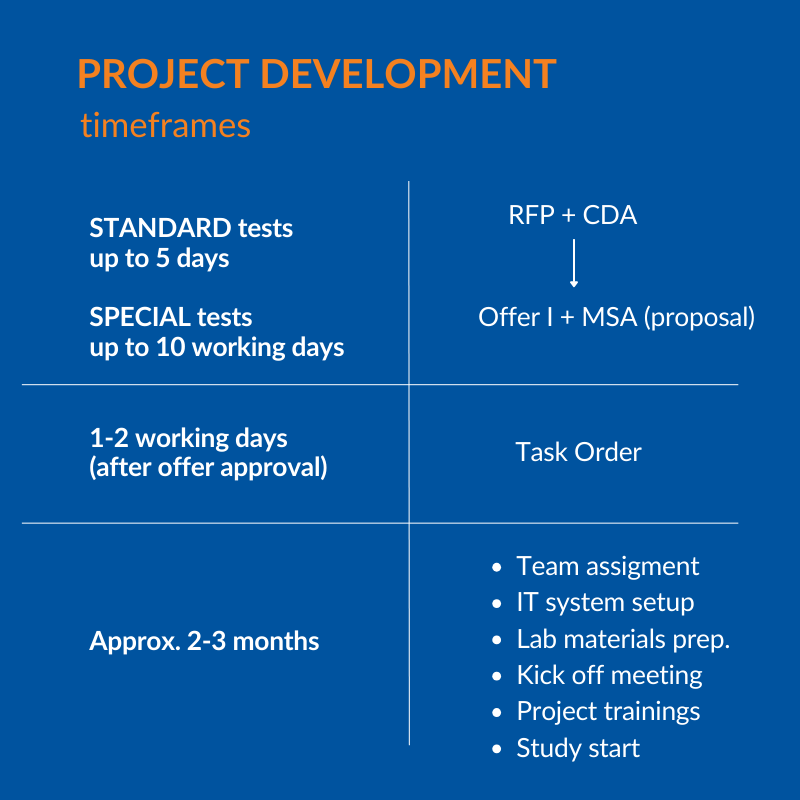
Typical duration: up to 5 working days for standard tests(as safety profile) and up to 10 working days for more complex and specialistic tests.
The setup process usually begins with two parallel elements. A CDA (Confidentiality Disclosure Agreement) enables the secure exchange of protocol and study information. At the same time, the RFP (Request for Proposal) defines the initial scope, assumptions, and expectations regarding services, timelines, and responsibilities.
This phase is often underestimated. The level of detail provided in the RFP has a direct impact on feasibility assessment and on how efficiently the next steps can proceed.
Offer and MSA (Proposal)
Typical duration: 1–2 working days once the offer is approved, with continuous contact during clarification.
Following the RFP review, an offer is prepared together with an MSA (Master Services Agreement) proposal. This stage establishes the legal and commercial framework for cooperation and confirms the general conditions under which the study will be executed.
While documentation is essential, timeline pressure at this stage usually comes from internal decision-making rather than document preparation itself.
Task Order
Typical duration: 1–2 working days, with constant contact once the offer is approved.
The Task Order converts the general agreement into a study-specific operational plan. At this stage, we work closely with the Sponsor or CRO to translate the approved offer into concrete activities, responsibilities, and timelines. This includes confirming the exact scope of work and agreeing on deliverables such as reports, datasets, laboratory outputs, system access, or required study documentation.
Because the main assumptions are already aligned earlier in the process, this step focuses on precision rather than redefinition. A clearly defined Task Order removes ambiguity before execution begins and provides a shared operational reference for all parties involved.
Team Assignment
Once the Task Order is confirmed, dedicated teams are assigned to the study. This includes project management, operational, laboratory, and support functions.
Team assignment ensures clear ownership, defined communication pathways, and accountability from the very beginning of the study lifecycle. It also enables parallel preparation across different workstreams.
Kick-Off Meeting
The kick-off meeting formally aligns all stakeholders involved in the study. During this meeting, scope and timelines are confirmed, communication and reporting rules are agreed, and escalation pathways are defined.
This moment marks the transition from planning to execution readiness and sets the tone for cooperation during the study.
Learn more about the Preparation Phase at Central Lab.
Study Start and Overall Setup Duration
From Task Order through team assignment and kick-off, the full study setup phase typically takes approximately 2–3 months.
This timeframe reflects a controlled and realistic approach to setup — one that allows proper preparation without compressing steps that are essential for quality, compliance, and operational stability. This includes project-specific team training, system configuration, preparation of kits and materials, as well as the development of study documentation and operational instructions. These activities are essential for delivering the study in line with GCP, CLP, and applicable regulatory requirements.
Learn more about the Study Setup Phase at Central Lab.
What Happens After Study Start?
Once the study is live, focus shifts to execution for the full duration of the clinical trial, in line with the protocol and study milestones. During this phase, structured communication and reporting are maintained, quality oversight is continuous, and cooperation between all parties remains active throughout.
As the study approaches completion, activities move into database close and study closeout. These steps typically take place at the end of the study or in its final phase, depending on protocol design and data flow. In parallel, study-specific materials and outputs are finalized, including laboratory manuals, study collection sets, analytical plans, and system access documentation.
Learn more about the Execution phase at Central Lab.
Where is there space for time negotiation?
Timeline discussions are meaningful when they focus on how work is organized rather than whether key steps can be skipped.
Time optimization is most realistic when requirements are clearly defined early, decision-makers are involved from the start, and parallel activities are enabled. Short communication paths and early alignment often make a measurable difference.
What cannot be safely compressed are contractual integrity, proper team onboarding, quality controls, and data integrity safeguards. Accelerating these areas may shorten setup on paper but often creates delays and rework later.
Closing Perspective
A study setup timeline is not about moving as fast as possible. It is about creating a stable foundation for execution, predictable collaboration, and reliable data.
When setup is treated as a strategic phase rather than an administrative formality, timelines become clearer, expectations more realistic, and studies easier to run once they go live.
If you’re planning a new study or preparing an RFP, align timelines early.
References
- ICH E6(R3) Guideline for Good Clinical Practice (GCP), European Medicines Agency, access date: 05.02.2026
- Documentation in Clinical Trials, Badania Kliniczne, access date: 05.02.20264
- RFP in Clinical Trials: A Guide to CRO Vendor Selection, IntuitionLavbs, access date: 05.02.2026
FAQ about study setup timeline
1. What is a typical study setup timeline in clinical trials?
A typical study setup timeline in clinical trials ranges from several weeks to a few months, depending on study complexity, contractual processes, regulatory requirements, and operational readiness of sponsors, CROs, and central labs.
2. What factors have the biggest impact on the study setup timeline?
The study setup timeline is mainly shaped by contract finalization, scope definition, availability of study documentation, system setup, team readiness, and the speed of decision-making across involved partners.
3. Where can the study setup timeline be shortened without risking quality?
The study setup timeline can be shortened through parallel workstreams, early alignment on scope and deliverables, timely document readiness, and early engagement of operational teams – without compromising compliance or data integrity.
4. Which parts of the study setup timeline cannot be compressed?
Certain elements of the study setup timeline cannot be compressed without risk, including quality processes, regulatory documentation, system validation, and project-specific team training required under GCP and applicable regulations.
5. How can sponsors and CROs better plan their study setup timeline?
Sponsors and CROs can better plan the study setup timeline by involving key partners early, defining clear responsibilities, preparing documentation in advance, and aligning operational readiness before formal study start.